
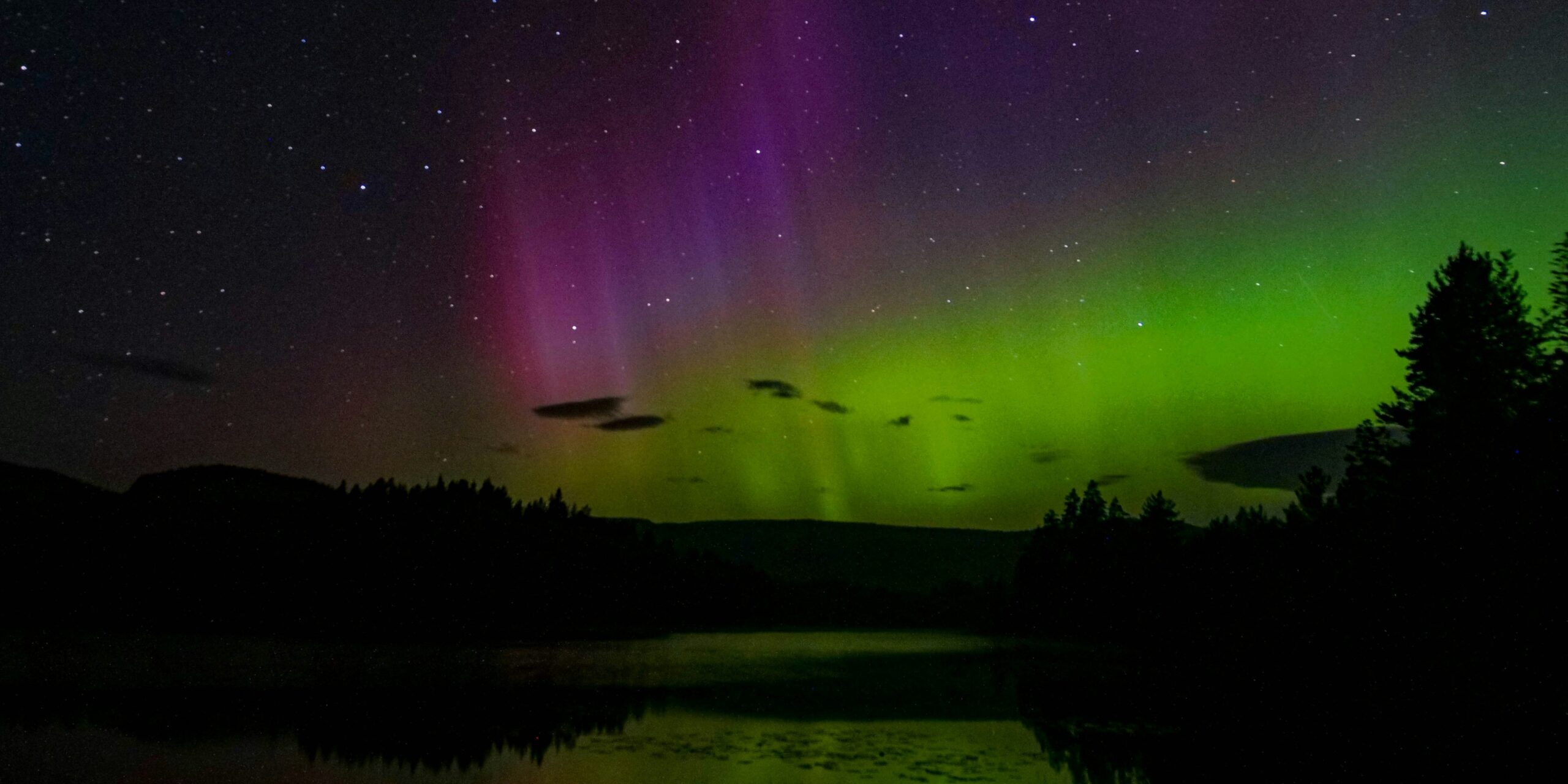
On the evening of December 9, 2025, a remarkable natural phenomenon captivated skywatchers across the United States. A rare aurora borealis display, typically seen only in far northern regions, lit up the night skies in parts of the lower U.S. This stunning celestial event was triggered by a strong surge of solar activity, including a powerful coronal mass ejection (CME) from the Sun. The CME sent a burst of charged particles hurtling toward Earth, causing the atmosphere to light up with vibrant green and purple hues. These hues, characteristic of the northern lights, are usually visible only in higher latitudes near the Arctic, making this event all the more extraordinary for residents in lower regions of the U.S.
The auroras were visible across a wide swath of the country, reaching areas far beyond the typical reach of the northern lights. In a rare occurrence, people in states such as Michigan, Wisconsin, and parts of the Pacific Northwest were able to witness the dazzling display. This was a once-in-a-lifetime opportunity for many to experience a phenomenon that is usually reserved for countries like Canada, Norway, and Sweden, where the auroras are a regular feature of the winter sky. The auroras were particularly intense that night due to the unusually powerful geomagnetic storm triggered by the CME. As a result, the aurora borealis was visible even in regions farther south, making it one of the most far-reaching auroral displays in recent memory.
For those hoping to catch a glimpse of the phenomenon, clear skies and dark, open areas were the best conditions for viewing. While the auroras were visible to many, their brightness and intensity varied depending on local weather conditions, such as cloud cover. Cities with significant light pollution had less optimal conditions for viewing the auroras, as the glow of artificial lights can obscure the natural beauty of the phenomenon. However, areas with less light interference, particularly in rural regions, had the best chance to witness the spectacle in its full glory. The vibrant colors—predominantly green with tinges of purple and pink—could be seen dancing across the night sky, creating an almost otherworldly atmosphere for those lucky enough to witness it.
The event on December 9 marked a significant moment in the ongoing solar cycle, as solar activity tends to increase in intensity over time. This increase in solar activity is expected to result in more frequent geomagnetic storms, which could potentially bring more auroral displays to southern regions in the coming years. While the northern lights are typically associated with areas within the polar regions, solar events like the one on December 9 show that these spectacular displays are not always confined to the far north. As solar storms become more intense, the chances of seeing auroras in more southern locations will continue to grow.
For many, this rare opportunity to see the aurora borealis outside of the traditional northern latitudes was a thrilling and unforgettable experience. The northern lights, with their shifting colors and ethereal glow, have long been a source of wonder and fascination. For those in the U.S. on December 9, 2025, it was a moment to remember, a glimpse of the mysterious beauty of our planet’s natural wonders that few people will ever experience in their lifetime.
The display of the northern lights on December 9 was not just a breathtaking visual experience, but a reminder of the power and unpredictability of our solar system. The CME that triggered the auroras was a reminder that our Sun continues to have a profound effect on Earth, creating dazzling light shows that inspire awe and wonder. For skywatchers across the United States, this rare event was an unforgettable celebration of nature’s beauty, one that will likely be remembered for years to come.
