The Phoenix Lens Method: How Dr. Nicole Schtupak Is Connecting Medicine, Education, Sports, and Personal Growth
Dr. Nicole Schtupak turns lessons from medicine and adversity into a platform focused on education, resilience, and human potential.

Some philosophies begin in classrooms or business meetings. For Dr. Nicole Schtupak, the ideas behind The Phoenix Lens Method developed through a life shaped by adversity and a career spent making decisions where details matter. Abandoned as an infant and left fighting to survive, Schtupak experienced uncertainty long before she entered medicine. Decades later, her personal history and professional experience have converged into a platform centered on perspective, critical thinking, and human potential.
How Medicine Shaped The Phoenix Lens Method
The Phoenix Lens Method grew from observation rather than from a conventional plan to create a personal development platform. Throughout more than 25 years of professional experience, Schtupak has worked across demanding areas of healthcare, including emergency medicine, critical care, internal medicine, infectious disease, interventional radiology, and high acuity care.
Those environments repeatedly reinforced an important lesson: what appears obvious at first may not reveal the complete picture.
In clinical medicine, symptoms can point in several directions. Assumptions can affect judgment, and reaching a conclusion too quickly can mean overlooking information that changes the entire case. Schtupak began recognizing that the same principle could apply outside medicine. People also form conclusions about their abilities, circumstances, identities, and futures based on what they initially see.
"Sometimes the answer is not in the thing we are looking at, but in the thing behind the thing," she says.
That idea became one of the foundations of The Phoenix Lens Method.
Teaching People to Think Beyond the Obvious
Education has played an equally important role in Schtupak's professional development. Over the years, she has educated and mentored future healthcare professionals while participating in academic and professional leadership, including roles connected with the Florida Academy of PAs and the AAPA House of Delegates.
Her approach to education emphasizes more than memorizing clinical information. She encourages learners to investigate, reconsider assumptions, and understand the reasoning behind a decision.
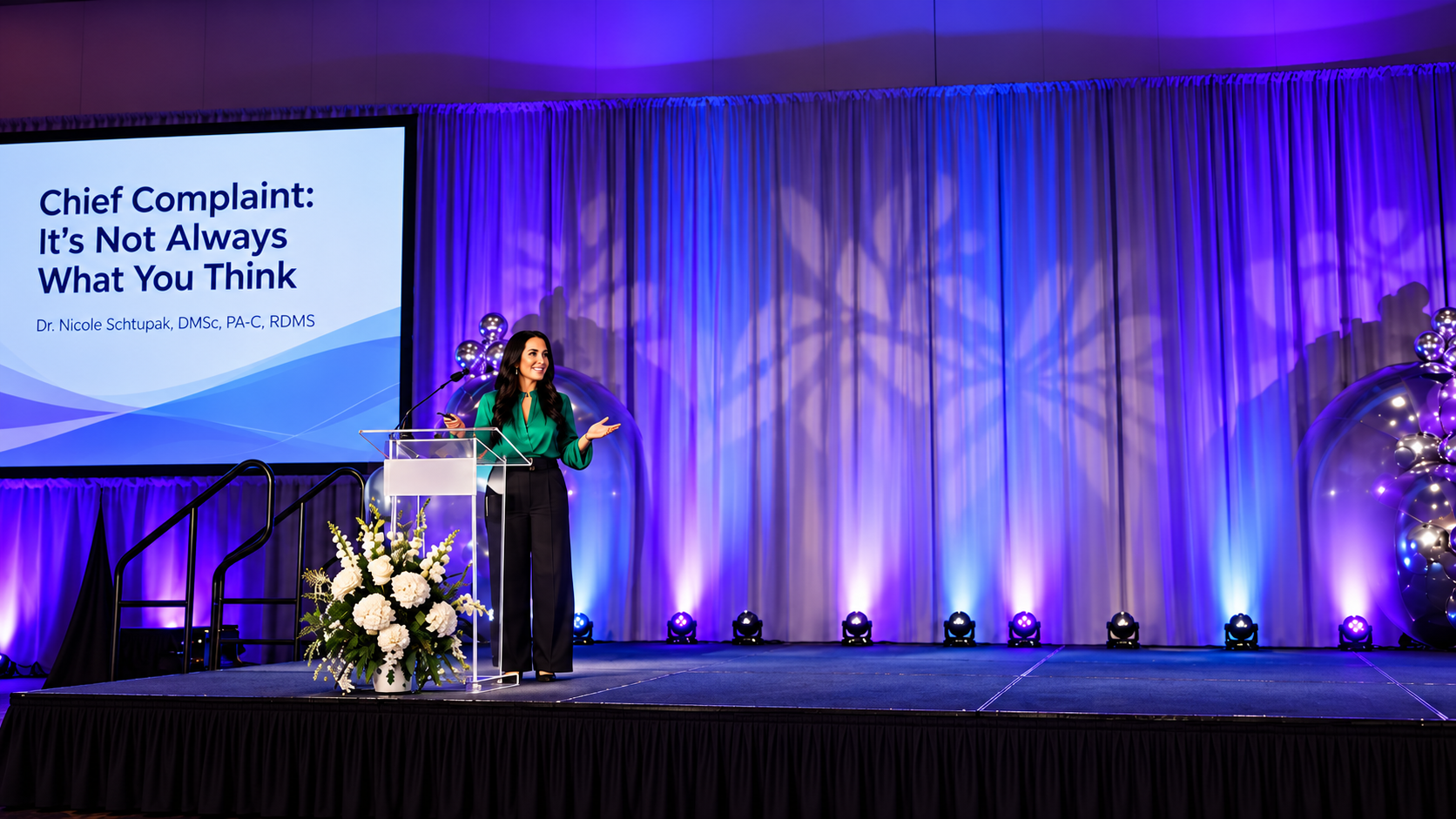
That philosophy can also be seen in topics she has presented, including "Chief Complaint, Not Always What You Think" and "Acute Pain, Understanding Bias, and Treatment Options." Both reflect a recurring theme in her work: better understanding often begins when people become willing to question their first interpretation.
Students have described that mentorship as having an impact beyond clinical instruction. "She challenged me professionally, and there was authentic personal development and growth by the end of the rotation," recalls Daniella Garamella, BSN, RN, PA S2.
Schtupak keeps cards from former students and mentees displayed in her office. Collectively, they represent something difficult to capture through credentials alone: the human relationships created when education combines knowledge with mentorship.

Turning Clinical Curiosity Into a Human Framework
Schtupak's work as a medical author further reflects the investigative mindset behind The Phoenix Lens Method. Her published work includes documentation of a rare case of infective endocarditis, an experience that required careful clinical reasoning and attention to findings outside the expected pattern.
That same willingness to examine what lies beneath an initial impression eventually became relevant to a much broader question: What happens when people apply similar curiosity to their own lives?
The result is a philosophy that connects professional reasoning with personal reflection. In medicine, changing perspective can reveal information that was previously overlooked. In personal development, reconsidering perspective can expose assumptions, beliefs, and possibilities that may have gone unquestioned.
The Phoenix Lens Method grew at that intersection.
From One Idea to a Growing Ecosystem
Rather than developing into one narrowly defined service, The Phoenix Lens Method has expanded across several areas of Schtupak's work. Education, sports medicine, mentorship, writing, speaking, and personal growth each provide a different setting for applying the same central concept.
Within healthcare education, the philosophy encourages students and clinicians to consider the entire patient and think critically about the information in front of them. Through Phoenix Lens Sports Medicine, Schtupak brings together clinical experience, student mentorship, experiential education, and engagement within athletic communities.
Her memoir, The Phoenix Diaries: A Journey of Pain, Power, and Purpose, approaches the philosophy from a more personal direction. Schtupak uses her life story to explore questions surrounding adversity, identity, resilience, and purpose.
Speaking and coaching extend those ideas further by encouraging individuals to examine how their interpretation of circumstances can influence the choices they recognize as available to them.
The applications vary, but the philosophy remains consistent.
"Change the lens. Change what you see," Schtupak says.
Why A Different Perspective Can Matter
The concept sounds simple, but its implications can be significant. Perspective influences what people notice. What they notice affects what they understand. Understanding, in turn, shapes what they decide to do.
"The lens through which we view a problem can change what we see, what we understand, and ultimately what we do next," Schtupak explains.
In healthcare, that mindset can encourage practitioners to reconsider assumptions and look more carefully at the whole patient. In education, it can help students become more deliberate thinkers. In sports environments, mentorship can connect physical performance with learning and personal development. In everyday life, examining an established perspective can create space for a different interpretation of past experiences or future possibilities.
Schtupak's own story provides the personal context behind that philosophy. Her earliest circumstances were beyond her control. What followed, however, became a life increasingly centered on learning, medicine, mentorship, leadership, and helping others examine what they might otherwise overlook.
Where The Phoenix Lens Method Goes Next
The Phoenix Lens Method continues to evolve because its central principle is not limited to one profession. Schtupak has taken lessons developed through medicine and applied them to education, sports, mentorship, writing, and personal development without abandoning the clinical reasoning that helped inspire the platform.
That connection gives the ecosystem its identity. Its focus is not simply on adopting a more positive outlook. Instead, the method encourages people to examine situations more completely, question automatic conclusions, and consider whether a different perspective might reveal something previously hidden.
For Schtupak, the journey from a difficult beginning to a multifaceted career has made that concept deeply personal. Her work brings together disciplines that might otherwise seem separate, connecting them through curiosity, perspective, and a willingness to look beyond the first answer.
Readers can explore The Phoenix Lens Method, Schtupak's educational work, sports medicine initiatives, speaking, coaching, and The Phoenix Diaries: A Journey of Pain, Power, and Purpose to learn more about the ideas shaping the platform.
Ultimately, The Phoenix Lens Method asks a deceptively simple question: What might become possible when you change the way you see what is already in front of you?
Learn more about Dr. Nicole Schtupak through The Phoenix Lens Method, LinkedIn, Instagram, and YouTube. Readers can also discover her story in The Phoenix Diaries: A Journey of Pain, Power, and Purpose.

This article features partner, contributor, or branded content from a third party. Members of the Today US editorial staff were not involved in the creation of this content. All views and opinions are those of the contributor alone.

You may also like
Beyond the Adjustment: Dr. Don MacDonald’s Polyvagal Approach to Chiropractic Care
Peaceful Households Through Ancient Wisdom

Alka Bohorun Is Turning Small Acts Into A Global Blueprint For Community Change

How Phaedra Solutions Helps Businesses Build and Launch AI Products

Vision Ranking Turns Google Visibility Into Growth