The Space to Return
From the skies to the stillness of Morocco, author and retreat founder Moulay Hicham Aamalki explores what it means to come home to ourselves.
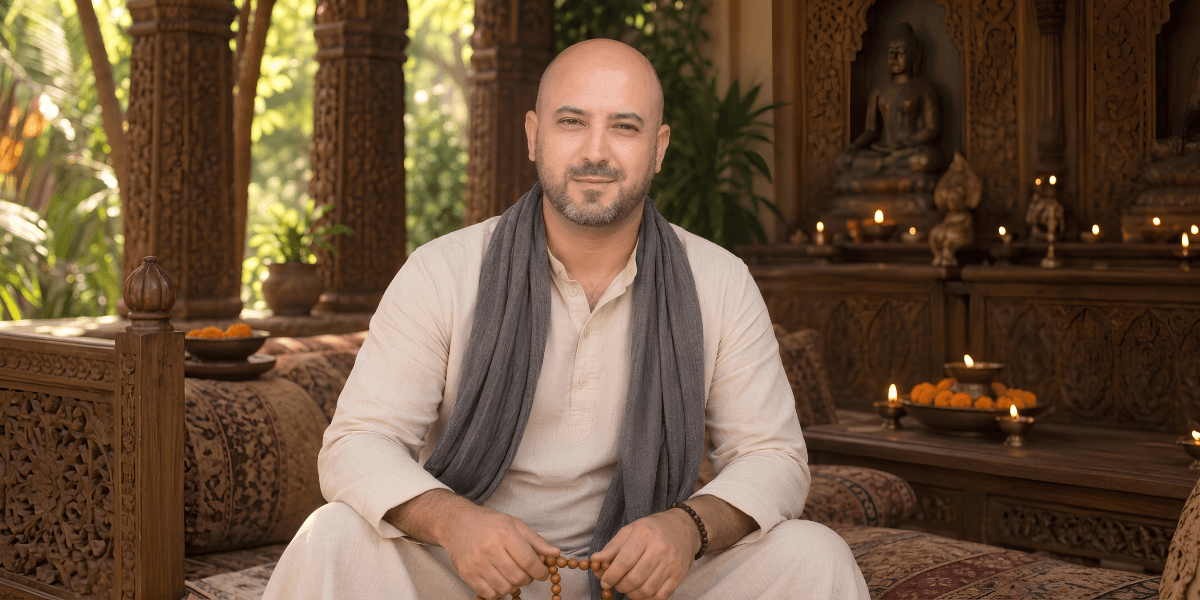
For nearly three decades, Moulay Hicham Aamalki traveled the world helping others reach their destinations.
He learned to anticipate needs, navigate cultures, and create comfort in unfamiliar places. In luxury hospitality and international aviation, he encountered thousands of people, each carrying a story that rarely appeared on a boarding pass.
Some were celebrating. Some were grieving. Others were simply trying to get through the day.
And somewhere along the way, a question began to take shape.
What are we carrying that no one can see?
For Aamalki, the question would eventually become deeply personal.
Born in Morocco and later building a life in the United States, he understood what it meant to move between worlds. He knew the expectations that accompany belonging, the identities we construct to navigate unfamiliar environments, and the quiet ways people learn to adapt.
He also came to recognize how easily a life devoted to achievement, responsibility, and caring for others can leave little room to ask a more intimate question:
Where am I in the life I have worked so hard to build?
The answer did not arrive through another destination.
It began with the willingness to stop.
The Inner Journey
Aamalki's exploration of healing grew from lived experience and an increasingly profound curiosity about the relationship between the body, mind, and the stories people tell themselves.
He pursued a degree in somatic wellness in the United States and later traveled to India for advanced studies and certification in Pranic Healing.
These paths offered different perspectives on human experience. Somatic approaches encouraged attention to bodily sensations and responses. Mindfulness invited him to observe thoughts without automatically identifying with them. His studies in India introduced him to additional contemplative and energy-healing traditions.
Together, they deepened a question that had followed him across continents.
How much of what we call our identity is who we truly are, and how much is what we learned to become?
The roles we assume. The beliefs we inherit. The meanings we attach to painful experiences. The protective patterns that once helped us navigate difficult circumstances but may no longer serve us.
Aamalki became interested not only in what people carry, but in what happens when they finally have enough space to examine it.
Not to erase the past.
Not to deny what happened.
But to understand how it continues to shape the present.
A moment of discomfort might invite a closer look at an old belief. An unexpected emotional reaction might become an opportunity for reflection. A familiar pattern might reveal itself not as an immutable part of someone's identity, but as something learned.
Such discoveries cannot be promised or scheduled. They require time, willingness, and, often, appropriate support.
For Aamalki, the purpose of healing is not to manufacture a flawless version of the self.
It is to develop a more conscious relationship with the person who has been there all along.
Why Morocco?
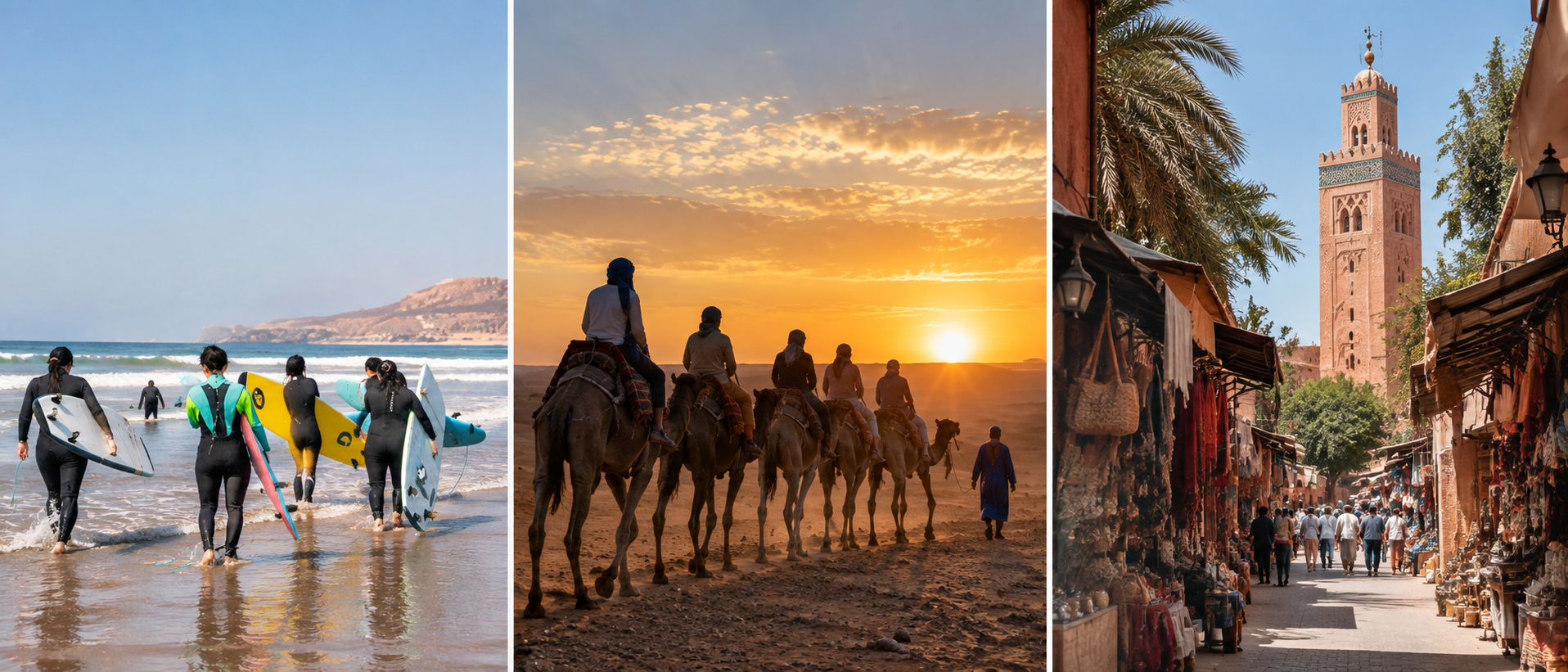
When Aamalki founded Ease Healing Retreats, he chose to return to the country that had shaped his earliest understanding of the world.
Morocco was more than a destination.
It was home.
A place of contrasts, where the vibrant movement of Marrakech gives way to the silence of the Sahara, where hospitality is expressed through gestures as much as words, and where the landscape itself seems to invite a different relationship with time.
He envisioned journeys in which people could temporarily step away from the relentless demands of everyday life.
Not to escape their lives, but to encounter them with greater awareness.
His approach draws upon nearly three decades of hospitality and aviation experience. Thoughtful accommodations, seamless transportation, cultural immersion, and attentive hosting are not simply expressions of luxury. They are ways of reducing the practical demands of travel so that guests have more room to rest, reflect, and experience the destination.
The intention is to create an atmosphere where people can feel welcomed, supported, and free to engage at their own pace.
A retreat cannot guarantee emotional healing or a particular transformation.
But it can offer something modern life rarely protects.
Space.
Space to notice the thoughts that have become habitual.
To question beliefs that may no longer reflect who we are.
To recognize the roles we perform and the expectations we have mistaken for identity.
To sit with questions that have been postponed for years.
And perhaps, to hear an inner voice that has grown quiet beneath the noise.
Two Landscapes. Two Ways of Listening.
Through Morocco Unveiled, Aamalki invites guests into a journey that moves from Marrakech toward the Sahara Desert.
The experience brings together Morocco's cultural richness, traditional hospitality, mindful practices, and moments of reflection.
There is something extraordinary about the contrast.
The movement of the souks. The intimacy of a riad. The changing landscape beyond the city.
And then the desert.
A camel journey in the golden light of late afternoon. A luxury tent beneath an immense sky. A silence that asks nothing of the person sitting within it.
For some, such moments are simply beautiful. For others, they may open space for questions that rarely surface in ordinary life.
Aamalki does not believe every meaningful experience needs to be interpreted or turned into a lesson.
Sometimes, being fully present is enough.
His second Signature Journey, Ocean Flow, follows a different rhythm along Morocco's Atlantic coast in Taghazout.
Here, yoga, surfing, movement, and mindful reflection unfold alongside the ocean.
Where the desert invites stillness, the waves invite participation.
The body moves. Attention returns to the present. The familiar need to control every moment encounters an environment that cannot be controlled.
Neither journey asks guests to arrive as a particular kind of person.
The invitation is to come as they are.
To explore. To rest. To connect. To notice.
And to allow the experience to remain their own.
Beyond Morocco: A Calling That Crosses Borders
Aamalki's journey into healing also led him to Rishikesh, India, where his studies and personal experiences deepened his connection to contemplative traditions.
That relationship inspired Heal Within, an intimate annual retreat beside the Ganges.
Its setting is different from Morocco's desert and Atlantic coastline, yet the underlying intention remains unchanged.
Whether sitting near the river in Rishikesh or beneath the stars in the Sahara, the invitation is not to collect another extraordinary destination.
It is to consider what becomes possible when we stop filling every moment.
For Aamalki, the external journey can create the conditions for an internal one.
The landscape offers a setting.
The practices offer opportunities for awareness.
But the meaning belongs to the individual.
When the Journey Becomes a Book
Eventually, the questions shaping Aamalki's retreats found another expression.
Writing.
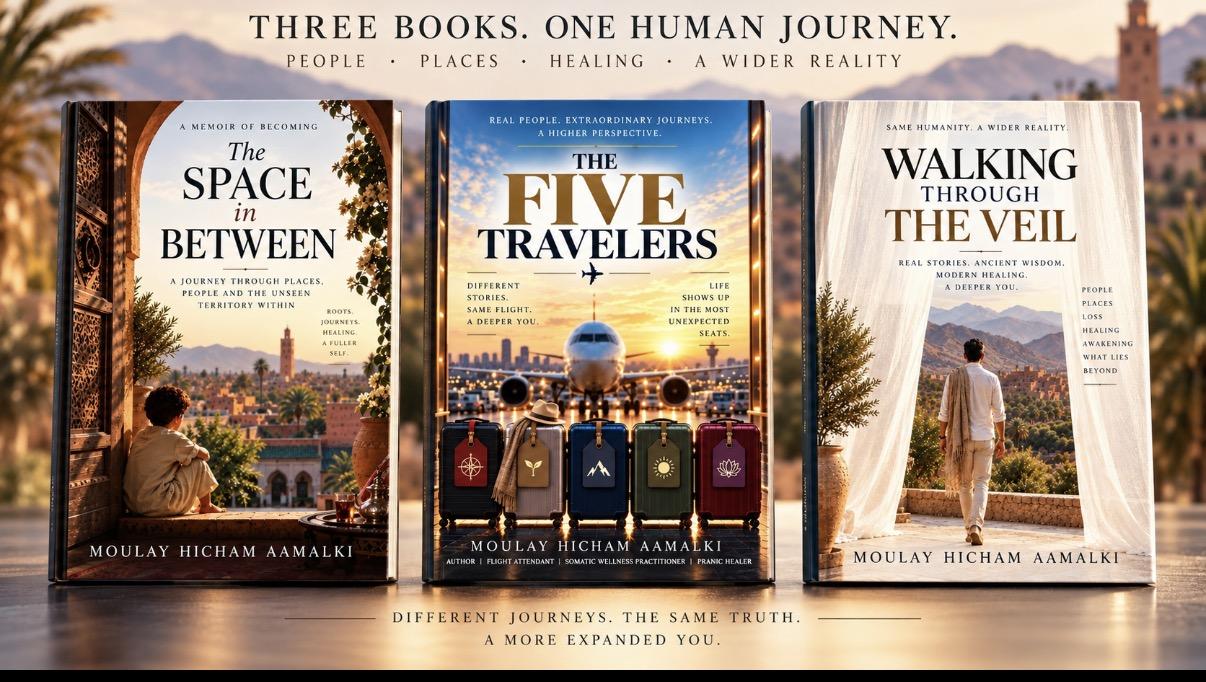
His forthcoming memoir, The Space in Between, begins in Morocco and moves through the experiences that shaped his understanding of identity, belonging, survival, and healing.
Blending personal narrative with reflections on psychology, neuroscience, mindfulness, and somatic awareness, the book explores the distance between who we are, who we learned to become, and who we may still discover beneath the roles we carry.
It does not offer a portrait of a man who has arrived at perfect understanding.
Instead, it makes room for uncertainty, contradiction, and the unfinished nature of being human.
His second forthcoming book, The Five Travelers, returns to the world of international aviation.
Inspired by encounters accumulated over nearly three decades in the air, it brings humor, tenderness, and psychological reflection into the intimate space of an aircraft cabin.
A passenger. A conversation. A moment of turbulence.
Ordinary encounters become invitations to look beyond appearances and consider the unseen experiences people bring into shared spaces.
The book's deeper meaning unfolds gradually, preserving a discovery that belongs to the reader.
A third forthcoming work, Walking Through the Veil, continues Aamalki's literary exploration of identity and the inner journey, asking what becomes possible when the beliefs and roles that once defined us begin to loosen their hold.
Together, the books extend his work beyond the destinations of his retreats.
A reader does not need to travel to Morocco or India to encounter the questions at the heart of his writing.
A page can create its own kind of stillness.
A sentence can interrupt an old assumption.
A story can reveal something we have struggled to name.
For Aamalki, the books and retreats are not separate ambitions.
They are different expressions of the same calling.
The Meaning of Ease
There is a reason Aamalki chose the name Ease Healing Retreats.
He does not see ease as a permanent state of comfort or a life without difficulty.
Nor does he believe healing means reaching a place where painful memories, uncertainty, or difficult emotions disappear.
His philosophy is rooted in a quieter possibility: learning to meet ourselves with greater awareness, honesty, and compassion.
To recognize a familiar reaction before allowing it to dictate our response.
To question a belief without condemning the person who once needed it.
To understand that the identities we developed to navigate life do not have to define every chapter that follows.
And to acknowledge that sometimes the most courageous conversation is the one we have with ourselves.
It is a philosophy that brings Aamalki's life full circle.
The Moroccan child who grew up navigating expectations. The hospitality professional who learned the art of caring for others. The international traveler who witnessed countless human stories. The student who traveled to India seeking deeper understanding. The author who began putting his own questions into words.
Each chapter led him toward a different understanding of service.
Today, that service might take place in a Moroccan riad, beneath the Sahara's night sky, beside the Atlantic Ocean, along the Ganges, or within the pages of a book.
The setting changes.
The invitation remains.
To pause long enough to recognize what we have been carrying.
To examine the stories we have mistaken for ourselves.
And to remember that beneath the noise, the expectations, and the identities we have learned to inhabit, there may still be a quieter part of us waiting to be heard.
Perhaps coming home has never been only about returning to a place.
Perhaps it is also about returning to ourselves.
About Moulay Hicham Aamalki
Moulay Hicham Aamalki is a Moroccan-born author, founder of Ease Healing Retreats, and international hospitality and aviation professional with nearly three decades of experience. He pursued a degree in somatic wellness in the United States and advanced studies and certification in Pranic Healing in India.
His forthcoming books include The Space in Between, The Five Travelers, and Walking Through the Veil. Through his writing and curated retreats in Morocco and India, he explores identity, belonging, mindfulness, and the ongoing human journey toward greater self-awareness.
Learn more at www.easehealingretreats.com

This article features partner, contributor, or branded content from a third party. Members of the Today US editorial staff were not involved in the creation of this content. All views and opinions are those of the contributor alone.

You may also like

Preston Nelson Writes To Survive And Thrive

Beyond The Message: How Good Quality Human Is Redefining California Lifestyle Wear
Beyond the Adjustment: Dr. Don MacDonald’s Polyvagal Approach to Chiropractic Care
Peaceful Households Through Ancient Wisdom

Evolve Leadership And Development Leads From Within