The Missing Link Between Soil and Humanity: Why Modern Health and Agriculture May Be Missing the Same Critical Element
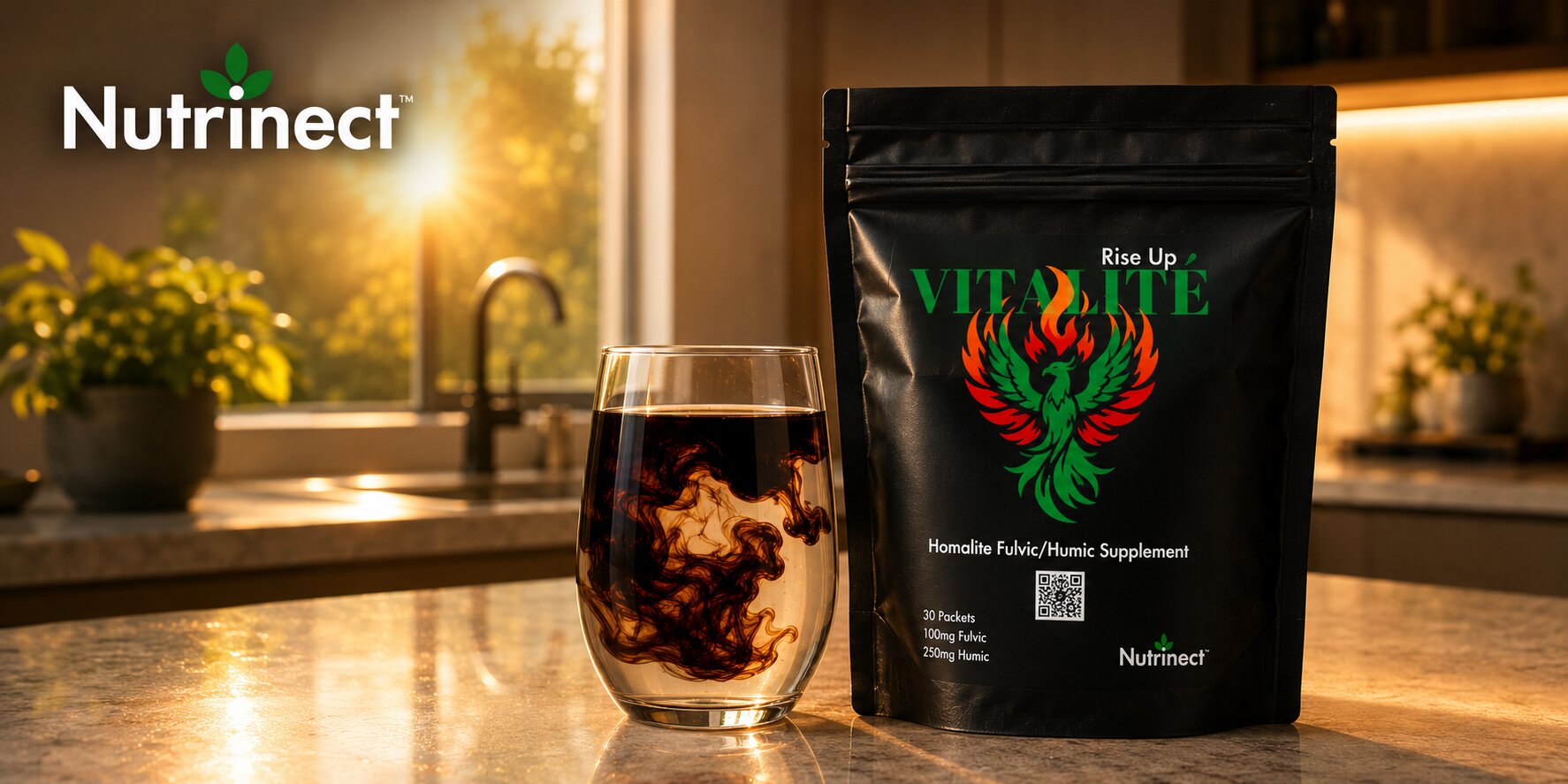
Discover how fulvic and humic compounds connect soil vitality, nutrient density, cellular health, and human health, and why source quality matters.
An emerging body of peer reviewed research is reshaping how scientists think about the relationship between soil vitality, cellular health, and nutrient efficiency. For decades, human health and agriculture were treated as separate conversations, yet researchers now point to a shared foundation: both systems rely on the same biological processes, and modern practices may have depleted critical supporting compounds from both.
That realization is driving renewed scientific interest in fulvic and humic substances, naturally occurring compounds formed through the microbial decomposition of organic matter over time. Historically studied for their role in soil fertility and nutrient transport, peer-reviewed research now also documents their role in supporting nutrient absorption, cellular function, detoxification pathways, and inflammatory regulation in the human body.
As interest grows, researchers and consumers are asking where these substances come from and whether source quality matters.
That question is becoming increasingly important as researchers and consumers recognize that source quality, purification methods, and preservation of both fulvic and humic fractions can significantly influence product quality and performance. These principles form the foundation of Vitalité Humalite from Nutrinect.
[IMAGE: https://bizweekly.com/wp-content/uploads/2026/06/download-1-6.jpg]
The Connection Between Soil and Cellular Health
The problem begins in the soil. One of the most widely cited peer-reviewed analyses of USDA food composition data found measurable declines in minerals, vitamins, and protein across 43 garden crops between 1950 and 1999 (Davis et al., Journal of the American College of Nutrition, 2004). For consumers, this means the foods we rely on for nutrition no longer provide the same nutrient density they once did.
Researchers have linked part of this decline to modern agricultural practices that can disrupt soil microbiology and reduce the natural production of humic and fulvic compounds. These compounds help support mineral chelation and transport within living soil systems. Without them, minerals may still exist in the soil but become less bioavailable to plants and, ultimately, to the food supply.
At the same time, the modern food supply is facing increasing scrutiny over chemical and heavy metal exposure. Government and independent testing have identified substances such as arsenic, cadmium, lead, mercury, glyphosate, and pesticide residues in a broad range of commonly consumed foods, including grains, processed products, and baby foods.
This growing combination of declining nutrient density and rising environmental exposure has renewed interest in humic and fulvic substances.
Peer-reviewed studies have documented the ability of humic substances to bind certain heavy metals and environmental compounds while also supporting mineral transport and nutrient availability. As a result, researchers are increasingly examining how these compounds function within both soil biology and human wellness systems.
The Missing Link That Used to Be Everywhere
What connects the soil to the cell? Fulvic and humic.
Fulvic is the smaller molecular fraction and has been studied for its ability to bind minerals into more bioavailable forms. Its low molecular weight, ability to pass through cell membranes, and stability across a wide pH range allow it to interact efficiently within biological systems. Researchers have explored its role in nutrient transport, mineral utilization, and cellular function, helping support the delivery of minerals to cells rather than simply passing through the digestive system unabsorbed.
Humic functions differently as the larger molecular counterpart. Laboratory studies have demonstrated humic’s measurable binding activity involving compounds such as arsenic, lead, cadmium, mercury, various agricultural residues, and environmental compounds, supporting the body’s natural detoxification and elimination pathways.
Historically, fulvic and humic compounds were naturally present in food grown in biologically active soil and were consumed regularly through plants, water, and root-based foods.
Beginning in the 1940s, agricultural practices increasingly shifted toward synthetic fertilizers and chemical-intensive farming methods that altered soil microbiology and reduced the natural cycling of humic substances throughout the food chain.
The same transition that increased environmental chemical exposure also reduced compounds historically associated with mineral transport and natural binding processes.
The result: a population now carrying measurably higher chemical burdens than previous generations while consuming fewer of the humic substances historically present in living soil systems.
Researchers now believe this combination may have created a significant disconnect: increased exposure to environmental compounds alongside reduced intake of the humic substances historically present. This growing body of research is one reason interest in fulvic and humic substances continues to expand across both agriculture and human wellness.
The Same Chemistry, Above and Below Ground
The connection between soil health and human health is direct: soil produces food, and food supports the body. The soil is the beginning of the human food chain. Many of the same agricultural practices that altered soil microbiology have also contributed to declining nutrient density and increasing environmental exposure within the modern food supply.
In living soil systems, fulvic substances help chelate and transport minerals into plant roots, influencing the nutrient profile of the foods eventually consumed. Humic substances interact differently, helping bind and stabilize compounds within the soil environment and influencing overall soil quality and biological balance.
Researchers are interested in these compounds because their underlying chemistry is consistent across agricultural and biological systems.
This expanding body of research is driving renewed interest in restoring these naturally occurring compounds to modern agricultural and nutritional systems. It has also highlighted an important distinction: the biological activity of humic substances can vary significantly depending on source material, concentration, and processing methods.
Why Source and Processing Determine Whether Any of This Works
If fulvic and humic substances matter, the next question is whether all sources are created equal. A 2025 review found that few supplements clearly disclosed their source material, concentration, or purification methods, making it difficult for consumers to evaluate purity, potency, or contamination risk. Vitalité Humalite has gained attention for its freshwater Humalite source, which contains a naturally high humic concentration and a distinct molecular composition compared with the lower grade leonardite and lignite sources commonly used throughout the industry. Research has identified important compositional differences that help explain why source quality matters and why not all fulvic and humic products perform the same way in agricultural and biological applications.
- Higher Oxygen-to-Carbon Ratio
Freshwater Humalite retains a higher oxygen-to-carbon ratio, supporting nutrient interaction, redox activity, and biological functionality compared with more heavily fossilized sources. - More Active Binding Sites
Humalite contains more active molecular sites, enabling more effective chelation, nutrient transport, and binding interactions with minerals and environmental compounds. - Preserved Nitrogen Structures
Unlike highly fossilized sources, Humalite retains more natural nitrogen, an essential building block of amino acids, proteins, and enzymes. - Open-Chain Carbon Structure
Unlike leonardite and lignite, Humalite’s open carbon structure supports more effective chelation and nutrient transport. - Natural Dual-Fraction Composition
While many products isolate a single fraction, Vitalité Humalite preserves both fulvic and humic fractions in their natural composition.
Source quality matters because it influences biological functionality, helping explain why some humic sources perform differently from others.
The Proof Grows in the Field
University of Alberta research found that applying Humalite to wheat crops increased grain yield, seed protein, and nitrogen use efficiency compared with conventional fertilizer programs. The same foundational chemistry demonstrated in agriculture is now being studied in human wellness. Processing also plays a critical role. Nutrinect’s patented Fulvic Isolation Technology™ (FIT™) uses a chemical free extraction process designed to preserve both fulvic and humic fractions and maintain the natural composition that distinguishes Humalite from alternative sources.
What Happens When You Restore the Source?
Nutrinect applies this same source and processing philosophy across both wellness and agriculture. Vitalité Humalite utilizes purified freshwater Humalite and patented FIT™ processing within a human wellness formulation, while YieldMax applies the same foundational approach within agricultural systems.
The result is a formulation philosophy centered on source quality, preservation, and transparency rather than marketing claims alone.
The underlying premise is simple: biological systems tend to perform best when they are supported with the foundational compounds they were historically designed to interact with.
For researchers, farmers, and consumers alike, the evidence points to the same conclusion: source quality matters.
Whether applied to agriculture or human wellness, the science continues to point back to the same principle: not all fulvic and humic sources are created equal. Understanding source, composition, and processing methods is essential to understanding performance. Learn more at Nutrinect.
These statements have not been evaluated by the Food and Drug Administration. These products are not intended to diagnose, treat, cure, or prevent any disease.
Follow ongoing updates and insights from the team on Tiktok, X and Facebook.
Disclaimer:
This article is for informational purposes only and is not intended to promote, encourage, or provide professional advice related to health, nutrition, or agricultural practices. Always consult a qualified professional or trusted authority before engaging in any activities related to dietary supplements, soil treatments, or regenerative agriculture, especially if doing so may have legal, financial, or personal consequences. The author and publisher are not responsible for any losses, damages, or outcomes resulting from the use or reliance on the information provided.

This article features partner, contributor, or branded content from a third party. Members of the Today US editorial staff were not involved in the creation of this content. All views and opinions are those of the contributor alone.

You may also like

From Orphanage to Congressional Recognition: Scarlet’s Inspiring Journey of Resilience and Success

From Struggling to Breathe to Building Everwild Apothecary: Corey Gawryl’s Journey to Natural Wellness

Kandé Is Changing The Conversation Around Modest Fashion With A Distinctly African Vision

Preston Nelson Writes To Survive And Thrive

Beyond The Message: How Good Quality Human Is Redefining California Lifestyle Wear