Beyond The Kardashev Scale: The First Space Exploration Model Built On Stages Of Consciousness

Kaikhan Salakhov presents a consciousness-based model of civilization, reframing space exploration through perception, ethics, and awareness.
The frameworks that have long dominated the measurement of civilizational progress evaluate external indicators alone. The Kardashev Scale and its successors quantify energy capture, technological capability, and spatial expansion, yet they remain structurally silent on the dimensions that determine what a civilization fundamentally is: its stages and states of consciousness, the modalities of awareness through which it operates, and the biological composition that gives rise to its sensory and perceptual architecture — the very substrate through which consciousness develops and progresses. Anthropocentric by construction, these models can only measure what their original premises permit them to see.
Kaikhan Salakhov’s engagement with this omission began in 2014 as a private inquiry, pursued in his free time. By 2016, the questions demanded a different commitment, and he redirected his life entirely around the research. Nine years later, the result was an 852-page work, Astral Space Exploration: The Cosmic Renaissance: The Fundamental Principles of Cosmocybernetics — the first model of space exploration that integrates stages of consciousness as a structural dimension of civilizational development. At its center is the ASX Grid, a framework Salakhov constructed and applied across fields: from architecture to biology, from interstellar cosmogeopolitics to spirituality and culture. The first edition presents the model’s initial application and demonstrates that its experimental deployment functions as intended.
A New Framework Beyond Power And Technology
For over half a century, scientific discourse has relied on the Kardashev Scale and its extensions. Subsequent alternatives — the Barrow Scale, the Sagan Scale, the Zubrin Scale — adjusted the axis but not the logic. They all measure capability. None measure the consciousness of the species, the architecture of its perception, or the developmental stage of the awareness directing that capability.
The ASX Grid asks not what a civilization can do, but what it is. It maps dimensions no prior framework has unified: how many senses govern a civilization’s perception of reality, what stages and types of consciousness it operates through, whether its cognition is linear or non-linear, whether it assumes a self or no-self, whether its structures are hierarchical or decentralized, whether it is biocentric, technocentric, biomechanical, or hybrid. Technology, in this system, is never neutral. It becomes an expression of the awareness directing it.
Consider that civilizations with radically different interstellar expansion strategies — xenophilic or xenophobic, militaristic or pacifistic, biocentric or technocentric — could all be classified as Type II for the simple reason that each can harness the energy of its star. The classification holds at the level of energy. It collapses everywhere else. An intelligence operating through non-linear cognition or modes of perception alien to human experience might register as Type 0 or I by every conventional metric — and yet operate at a depth humanity may never reach. Stanisław Lem’s Solaris gestured toward precisely this. Reducing fundamentally divergent civilizational logics to a single category reflects the boundaries of the original framework rather than the reality it describes — a limitation of what could be perceived, understood, and acknowledged at the time those models were formulated.
Salakhov’s position as an independent thinker is structurally significant to the model’s design. He is not a scientist by training. He is an artist whose work is grounded in scientific literacy and logical rigor, but unbound by the disciplinary conventions that have kept most frameworks species-centric. This independence is what allowed the ASX Grid to be conceived as a living framework — open by construction, designed to evolve as the questions it raises generate further inquiry, rather than as a closed system seeking to fix the terms of its own measurement.
The Multiplanetary Question We Are Not Asking
The push toward becoming a multiplanetary species has captured global imagination. Mars colonization, lunar bases, asteroid mining, orbital habitats — the technical roadmap is increasingly clear. What remains absent is engagement with the structural reality of multiplanetary existence once it is no longer marketing language but lived condition.
The first problem is communication. A message between Mars and Earth takes between three and twenty-two minutes one way. Beyond the solar system, delays stretch into years and decades. Every existing model of governance, economic verification, and cultural exchange assumes near-instantaneous communication. None survive without fundamental restructuring. The same delay creates a profound vulnerability: an SOS signal from a distant colony may take years to reach Earth, by which point exploitation, abuse, trafficking, or other forms of systemic harm — whether perpetrated by criminal networks, rogue actors, or the colony’s own internal authority — has already unfolded beyond intervention. Distance creates jurisdictional vacuums where harm becomes structurally unpunishable.
The second problem is divergence. No colony established on Mars, on the moons of the outer planets, or on any world humanity reaches further into the cosmos will remain culturally, politically, or biologically identical to Earth. Different gravity, atmosphere, radiation, and resource constraints will produce different evolutionary pressures over generations, and the deeper into space humanity expands, the more pronounced the divergence between one colony and another will become. Within each, fundamentally different ideological orientations will compete for the structural shape of the future — biocentric factions arguing for organic human evolution, technocentric factions advocating synthetic integration, biomechanical movements proposing hybrid forms. These are political wings that will reshape the constitutional foundations of every off-world settlement.
Salakhov frames these not as engineering challenges but as inevitable consequences of physics that demand a different civilizational architecture from the start — and beneath that, an architecture of consciousness, which he argues is the primal source of any cosmogeopolitical activity in the future. Without addressing the awareness directing the expansion, every structural solution becomes a temporary patch over a deeper failure. In his book, Salakhov engages directly with this question and with the broader architecture of problems surrounding space exploration, consciousness, and the civilizational dimensions that have remained largely unexamined until now.
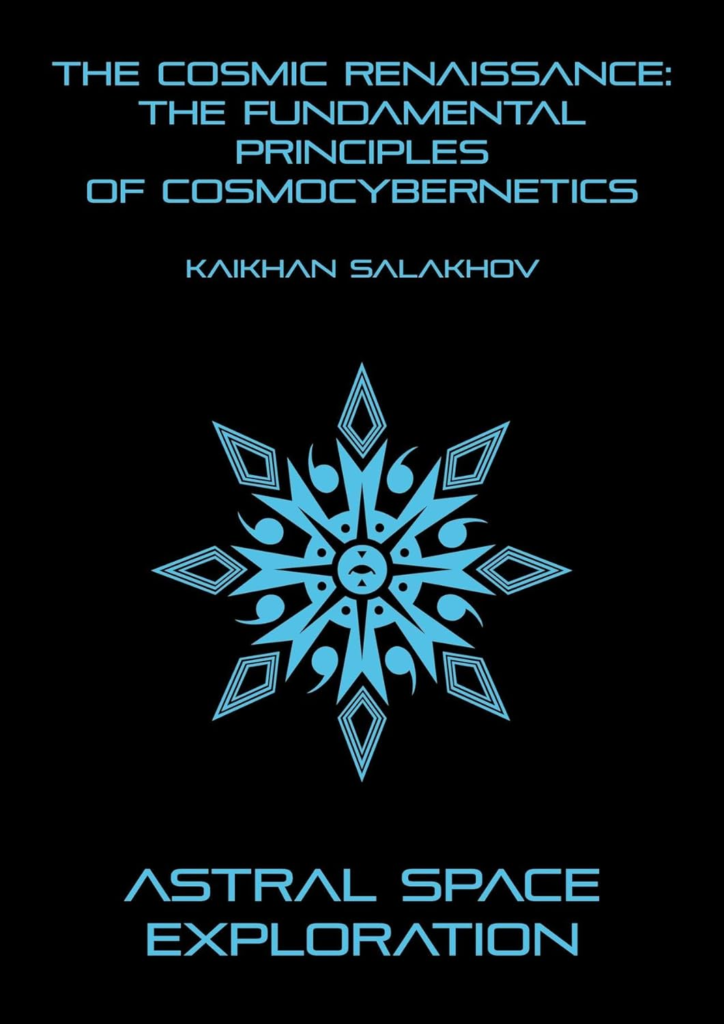
Architecture, Consciousness, And The Geometry Of The Eternal
Salakhov’s conceptual approach is rooted in his background in architecture. The principle that material systems evolve through stages led him to question why consciousness would not follow a similar pattern. This inquiry drew him toward integrative theories of development, which provided a structural language for mapping awareness. Yet none of those theories addressed space exploration, and like the existing space exploration models, they remained anthropocentric in scope. Salakhov found no sense of completion in any of them, and that absence eventually led him to develop his own framework — the work that would become the ASX Grid.
The visual dimension of the project emerged through geometry. Influenced by classical philosophy, Salakhov adopted geometric systems as a means of expressing multidimensional ideas. From this convergence emerged the thirty-six paintings of The Cosmic Renaissance, presented in a solo exhibition in Dubai in 2024. The works are produced entirely by hand using compass, ruler, oil and acrylics on canvas.
The first painting was completed in 2019 — two years before DALL-E 1, three years before Midjourney and Stable Diffusion. At the time, no software existed capable of generating geometric work of this kind. The decision to keep the body of work fully handmade was deliberate from the start, made with the foreknowledge that such tools would eventually emerge — and documented transparently through livestreams and ongoing uploads so the integrity of the practice remains verifiable.
The reason is structural. Geometry carries a legacy transmitted through the human hand for centuries — from Islamic architectural ornament to woven carpets to the geometric traditions of every classical civilization — and Salakhov chose to maintain that lineage out of respect for the time, focus, and devotion such work has always demanded. Geometry, in his view, is sacred. It must be respected.
Within the paintings, every line connecting one dot to another represents an interstellar pathway of flow — trade routes, communication relays, energy transfers, streams of information and consciousness — moving from planet to planet, star system to star system, galaxy to galaxy, universe to universe. Because each painting contains all stages of the ASX Grid simultaneously, the dots and lines operate across multiple registers at once: multiplanetary, interstellar, intergalactic, multiversal. The paintings are not separate from the theory presented in the book. They are part of it — the means of showing what words cannot, and of binding the entire structure into a single visual field that holds the micro and the macro at once. What text articulates in sequence, the paintings express in simultaneity.
Explore The ASX Grid Project
Readers, collectors, and thinkers interested in Astral Space Exploration Grid can explore the full project through its official platform at astralspacex.com. The complete book is available via Amazon. The artist’s portfolio is also available on Artsy.
Further insight into the artistic philosophy and process appears in a published feature at hube magazine interview, and ongoing updates can be followed through the artist’s official Instagram.

Today US Contributor
Hailey Anderson
Covers business, digital culture, and entrepreneurship, exploring how new ideas and technologies are changing industries.
This article features partner, contributor, or branded content from a third party. Members of the Today US editorial staff were not involved in the creation of this content. All views and opinions are those of the contributor alone.
You may also like
Michael J. Bannach: Where Does Controlled Data Go When an Engineer Uses AI?
How Phaedra Solutions Helps Businesses Build and Launch AI Products

Vision Ranking Turns Google Visibility Into Growth
NASA and SpaceX Prepare Crew-12 Astronauts for Return From the International Space Station

Kandé Is Changing The Conversation Around Modest Fashion With A Distinctly African Vision